
CAMBODIA: Diabetes - the silent killer
07 Feb 2011 14:53
PHNOM PENH, 7 February 2011 (IRIN) - When 46-year-old Cambodian motorbike taxi driver Gao Savvy broke his leg, he did not realize he would have to have it amputated, but he has had diabetes for five years and recently developed a condition called stenosis, a narrowing of the blood vessels, meaning doctors had no option but to amputate the injured leg.
“Now I only have my wife to take care of me. I don’t know what we’ll do next,” said Gao, who earned just US$50 a month.
Rapid lifestyle changes over the past two decades combined with poverty in Cambodia (according to government statistics, a third of the population lives below the national poverty line of 75 US cents a day) mean diabetes has become a major health problem.
The number of people with the disease is rising: Of the country’s 14.5 million inhabitants, about 352,000 adults live with diabetes, according to the 2009 Diabetes Atlas [ http://www.diabetesatlas.org/ ] published by the Belgium-based International Diabetes Federation. [ http://www.diabetesatlas.org/content/wp-data ]
In 2005, about 255,000 people suffered from diabetes, according to an article published that year in the Lancet, [ http://www.thelancet.com/journals/lancet/article/PIIS0140-6736(05)67662-3/abstract ] a UK-based medical journal. Two-thirds of all cases went undiagnosed before the survey.

In 2010, Cambodia had about 8,000 diabetes-related deaths, according to the International Diabetes Federation. By contrast, the government records more than 200 malaria deaths per year, and has calculated over 1,000 HIV/AIDS-related deaths each year since the most recent prevalence data were collected in 2006.
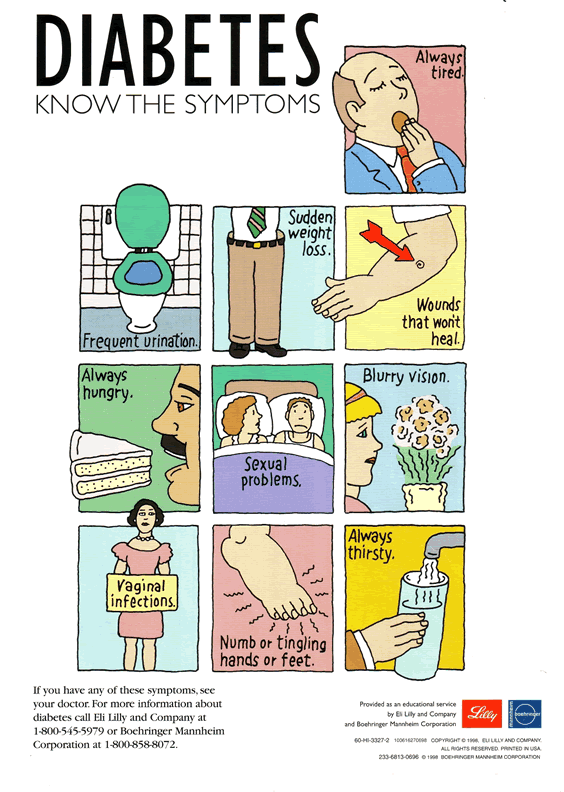
“It’s a silent killer,” said Lim Keuky, an author of the 2005 study and head of the Cambodian Diabetes Association. “You don’t know about it until the symptoms appear, and then it might already be too late.”
Keuky’s study found a surprisingly high prevalence (5 percent) in Siem Reap, a province in the northwest, and 11 percent in Kampong Cham Province in eastern-central Cambodia.
The relatively high rates of diabetes in Cambodia were surprising, the study said, given that the country is poor, and lifestyles are still fairly traditional.
Lifestyle changes
However, economic growth and urbanization mean many of Cambodia’s poor are eating processed food and not exercising enough, according to Denmark-based NGO the World Diabetes Foundation (WDF). [ http://www.worlddiabetesfoundation.org/ ]
These lifestyle changes have taken place on top of the hunger and desolation of the 1980s, the group said. [ http://www.worlddiabetesfoundation.org/composite-1183.htm ]
“Most processed and unhealthy food is the cheapest option while healthy foods have become increasingly costly and beyond the reach of the poor, so the poor have no control over the risk factors,” said WDF head Anil Kapur.
Meanwhile, campaigners say diabetes is not getting enough attention from international donors.
“Foremost is the misconception among donor agencies that these [non-communicable] diseases are diseases related to affluence, and do not affect the poor, which is completely untrue,” Kapur told IRIN.

About 80 percent of all diabetes cases are in low- and middle-income countries, affecting mostly people aged 45-64, says the World Health Organization (WHO).
Globally, about four million deaths are attributed to diabetes every year, compared to three million for AIDS-related illnesses and one million for malaria. Diabetes is responsible for about 5 percent of all deaths globally each year and the figure could rise by more than 50 percent in the next 10 years if urgent action is not taken, says WHO.
According to new research published by the Lancet, [ http://www.irinnews.org/Report.aspx?ReportID=91723 ] chronic diseases such as diabetes could kill up to 4.2 million people annually in Southeast Asia by the year 2030.
contributor/ds/cb
contributor/cb
© IRIN. All rights reserved. More humanitarian news and analysis: http://www.IRINnews.org
The Natural Solution


Introducing Bios Life™ – the only clinically proven, patented, safe and natural solution for complete cholesterol care.
Studied by:
1. The Framingham Heart Study
2. The Cleveland Clinic Study (America’s number one Heart Center for 15 Years, up to now)
3. The Type-II Diabetes Trials
4. The Philippines Trial
5. The Utah Trial
6. The Pacific Rim Trial
Contrary to most cholesterol products on the market, Bios Life ™attacks cholesterol problems in four different ways:
- Blocks re-absorption of cholesterol in the gastrointestinal tract
- Reduces absorption of cholesterol produced by the liver
- Blocks absorption of cholesterol from digested food
- Enhances enzymatic breakdown and removal of bad cholesterol from the body
The combination of these four mechanisms to balance cholesterol levels is revolutionary. The ultimate benefit of Bios Life™ for the cardiovascular system and triglyceride levels is only half the story. The immediate benefits of naturally regulating the absorption rate of nutrients and sugars by the body results in sustained energy, gradual weight loss, and a supported immune system.
Bios Life™ is the solution to imbalanced cholesterol levels and to the continual highs and lows associated with irregular absorption of nutrients and sugars. The appropriate application of the solution to these health problems results in the business opportunity.
Bios Life™ is the solution to imbalanced cholesterol levels and to the continual highs and lows associated with irregular absorption of nutrients and sugars. The appropriate application of the solution to these health problems results in the business opportunity.


No comments:
Post a Comment